Posts

The Joy of Writing

Image
Several years ago, I wrote this essay for another blog I have called “Beneath the Midlist.” I’m not as familiar with all WP’s bells and whistles and tend to “forget” to post there.   I really liked this blog and thought other writers might find it helpful to read so here it is. While it would be nice to make a living at writing, I never have. If I hadn’t married a Renaissance prince–a patron who shelters, feeds, and encourages me–I would never have had the opportunity to write. Sure, it’d be nice to rake in a lot of dough, but truth is, I’ve always written and I’ve never made a lot of money at it. But I have experienced a lot of joy. One of my favorite writing experiences occurred when I wrote a humor column for the local newspaper. I had a good friend who was an older woman who had worked tirelessly through the years to make our home town a better place. When I discovered, she had started the Girl Scouts organization in town and helped establish an arts alliance program, I...
The Handy Dandy Occupational Outlook Handbook

Image
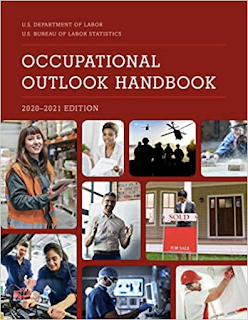
Most of us have a general idea of many careers. Our paths have usually crossed those of dentists, nurses, bank clerks, car mechanics, postal carriers, and librarians, just to name a few. But we’re not always well acquainted with professions other than our own. This is where the U.S. Bureau of Labor Statistics’ handy dandy Occupational Outlook Handbook comes in handy for writers. Never heard of this handbook? Well, if your main character insists on being a biological technician and you know nothing about this career, then this is the website for you. The OOH is stuffed with details about this profession and thousands of others. First of all, what is a biological technician? According to OOH, biological technicians assist biological and medical scientists. They set up, operate, and maintain laboratory instruments and equipment, monitor experiments, collect data and samples, make observations, and record results. A biological technician may also analyze organic substances, such as blood...

Let’s Revisit the Ripple Effect

Image
On May 25, 2015, I posted a blog titled “The Ripple Effect in Storytelling.” I wrote about consequences in setting up a scene. I was reminded of this blog when I recently watched Ryan Reynolds’ latest Netflick movie, The Adam Project . As a longtime Reynolds fan (Two Guys and A Girl!), it was fun to follow his adventures as a pilot from the future who goes back in time and encounters his younger self. Reynold’s character is wounded while stealing an aircraft to travel back in time. Although the bullet supposedly exited, its path was through his body, not a graze mind you, a bullet hole through flesh and organs and blood vessels–and he bleeds a lot. While he spends some time early on tending the exterior of the wounds, he ends up in several physical encounters with no visible problem of an untreated bullet wound in his side. In The Adam Project , the screen writers forgot about the ripple effect. What’s the ripple effect, you ask? Well, once something is introduced into the story...

Confessions of a Bookoholic

Image
2021 wasn’t too kind to my blogging. I was a sporadic blogger to say the least. Not only was there the pandemic to live around, we had once told our daughter we would move and live near her when she retired from her career in the U.S. Coast Guard. Needless to say, she retired and held us to our promise. Cleaning out and packing up a home after you have lived there for 25 years is not an easy job. Either physically or mentally. One of the most difficult choices I had to make was which books to move and which to donate. It was a difficult task and here’s why: I’m a bookoholic. I love books. Big books, tiny books. Fat books, thin books. Old books, new books. Fiction books, nonfiction books. Mysteries, romances, cookbooks, history books, biographies. I love them all. I buy books, I borrow books. I check them out of the library. I dug through a dumpster to save them when an Army library in Germany tossed them. Whenever I visit another city, I check out local bookstores and buy some book ...

Writing the Historical Romance Part 3

Image
Historical writers tend to love history and are often lured off the research track by fascinating historical tidbits. Frequently, the lure isn’t germane to the story being written. Which is why I find writing some type of outline or synopsis a great help once I’ve gained a feel for the historical period. This does not have to be a polished, submission level outline/synopsis. This is for your eyes only and can be as sloppy as you want. Probably the most important first step is establishing a time line. Why read about what happened in 1858 when your story takes place in 1812? Listing the basic elements of your story is another important step. In my November 19, 2019 blog I write about the essential story ingredients such as character, motivation, conflict, goals, etc. You can be as thorough here as you want. This is for your eyes only and can be as vague or detailed as you like. It’s easy to expand a word with a question mark into a sentence which eventually becomes a paragraph and the...

Writing the Historical Romance: Part 2

Image
Inspiration for a historical story can be triggered by a multitude of sources. Be it a sentence in a book, a personal experience, a dream, a podcast–the list is endless for source material. Today’s writer of historical can tap into a wide variety of autobiographies and biographies, historical nonfiction, and print or online magazines. Period films, movies, and documentaries are another favorite source. You never know what nugget of information will become the trigger for a story. If you enjoy history, inspiration never runs dry. The idea for my first published book, Stealing Destiny (aka Tennessee Waltz ) came from an item I ran across while reading about the Civil War. A Yankee officer had commandeered a horse from a woman in Virginia. After the war he wrote to her that the horse survived the war and was doing well. I thought the woman in Virginia, one of the most fought over states in the war, needed that horse more than he did. I decided to send my heroine after her horse. With a t...

Writing the Historical Romance: Part 1

Image
“Never write a historical novel as your first book.” I read this piece of writing advice in my first how-to-write fiction book. Youth and an undergraduate degree in history made me discard the advice. I spent the next two years writing a 900 page tome about Roman Britain set in 60 A. D. Gladiator it was not.  By the time, I wrote “The End,” the advice made sense. A novice historical romance writer is giving herself two difficult new skills to master: the craft of writing and the creation of a different time period.  The beginning writer of a contemporary story worries only about learning the craft of writing, because she can draw upon a store of shared contemporary images when she creates her setting. For example, the word “McDonald’s” puts the reader in a fast-food restaurant replete with smells.  Life isn’t as simple for the writer of historical novels. You don’t have this store of contemporary images and if your story is set before 1827, you can’t use the w...